Tuesday, 27 August 2013

Waze Reports integrated into Google Maps


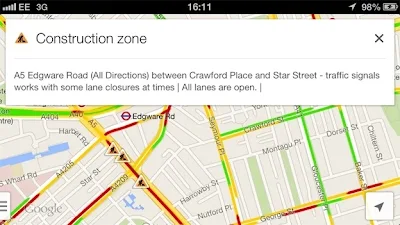
Waze was bought by Google ht two months ago, Waze Community GPS will allow in Google Maps to improve, at least on mobile. The first Advanced announced by Google Maps integration into the incidents of Waze community reports. The latter is however not the only one giving, since technology from Maps are also available to "wazers" said the Web giant. In recent years, the Waze app is available on iOS and Android, has attracted tens of millions of users. The Wazer’s statement during driving, allow the whole community to enjoy their statements in real-time accidents, traffic jams, police presence, radar, work stations, etc. Its acquisition two months ago by Google, for nearly a billion dollars, was not a surprise. In June, when formalizing the acquisition of Waze, Google did not hide his desire to improve Maps quickly. Yesterday, Google has confirmed this philosophy perfectly, announcing further concrete improvements on both sides. On Maps mobile users benefiting by getting reports from other Waze users about the incident reports in real time Waze users. This includes accidents also the work and road closures. Waze community can in turn benefit from the Google search, complementing already services including Foursquare and Yelp. The Waze map editor, which allows correcting some errors, also now it has Street View technology and satellite imagery from Google. Finally, note that the Federal Trade Commission, the government agency responsible for competition in particular to investigate the acquisition of Waze by Google. I must say that Maps is already one of the most important mobile applications in the world, crushing all competitors. And on the Web, its dominance is equally impressive. The acquisition of Waze can be interpreted as a strengthening of a dominant position. In the worst case scenario, it could go up to the cancellation of the acquisition of Waze. However, Google seems sure of himself in terms of comparisons between Maps and Waze.

Sony Xperia Z Ultra


Sony Xperia Z with 6.44 inch Ultra has an enormous Full HD screen. The Sony Xperia Z Ultra has a 6.44-inch full HD screen (1920x1080 pixels, 342 ppi) and is dust and water proof according to the norms IP55/IP57. So it not only looks similar to the Xperia Z. The Z Ultra is available in black and white. Sony's XL Smartphone is extremely large but also impressively thin of about 6.5 mm. The clear-edged design is very classy. Shade of this particular display affects the black model as a solid glass plate. The look is reminiscent of the Xperia Z, but in this format (17.9 x 9.2 inches), it is simply impressive. Even if it is only nine millimeters shorter than about Samsung's seven-inch tablet Galaxy Tab 3. The sleek and slim design ensures that the Z Ultra can still use it as a phone. This XXL Phone also the new Snapdragon processor by Qualcomm 800, clocked at up to 2.3 GHz. At least at first benchmark tests outdated processor all previous Smartphone processors significantly and it is twice as fast as the Galaxy S4 Snapdragon 600 processor with 3D graphics performance is about 50 percent faster than the S4. The RAM is lush two gigabytes. The internal memory is 16 gigabytes via microSD card but can be expanded up to 64 GB. Thanks to a generous 3,000 mAh battery, the Smartphone will still last long. In practice, however, the test battery was under intensive use similar fast running out as with other Smartphones. Sony promises brilliant colors for the "Triluminos” screen with OptiContrast technology. In the first vision test, confirms this: The screen in HD (1920x1080 pixels, 342 ppi) displays photos in vibrant colors that will not fade even when viewed from the side. He still acts as a whit more brilliant than its little brother, the Xperia Z. While the rather dark screen of the Galaxy Note and Note 2 is virtually impossible to read outdoors, working in the Ultra Z in sunlight by turning up the brightness to maximum barely possible. An innovation that has so far not a competitor: With any luck, you can use their old pencil as screen pen for writing and drawing. The camera uses an Exmor sensor with eight megapixel HDR function for photos and video. The first test photos showed decent image quality, but does not reach the level of 13-megapixel camera in the smaller Xperia Smartphones V and Z. In addition, the default automatic exposure yielded quite convoluted results. A quick start mode is supposed to ensure that you get off the sleep mode in less than a second, the first picture in the box. Design, processing speed and working are convincing. With the Sony Xperia Z Ultra delivers the most compelling current mobile phone giant over six inch diagonal display. The phablet bridges the gap between tablet and super phone - and can be used as a phone or tablet either.

Monday, 26 August 2013

Chrome 30 for Android with gesture control


Google has released a new Beta Version of Chrome for Android introduces new gesture controls and a tool for image search. Chrome 30 is available in beta since two days before for the Android edition, a series of news about the gestural controls. The Internet browser allows you to browse the active tabs by making a horizontal or vertical scanning. The same gesture is used to open the Options menu without lifting your finger from the screen. This beta version supports the accelerometer information so that websites will know the position of the Smartphone. Chrome 30 also introduced a new search tool for images. Holding your finger on an image, it opens a context menu option to access the "Search Google for that picture," which provides information on the plate, the web pages containing the same image and a selection similar image. This function is also available in the desktop version of Chrome 30 Beta.

Saturday, 24 August 2013

Vivo launches world's thinnest Smartphone


The Chinese Vivo launches the thinnest Smartphone in the world; the Vivo X3. With a thickness of only 5.75 mm, the device is thinner than 6.18 mm thick Huawei Acend P6, so far the worlds thinnest Smartphone. Despite its small thickness Vivo is still with a nice battery managed to stop with a capacity of 2000 mAh. In addition, the device is equipped with a 5 inch screen HD (720p), a 1.5 GHz quad-core processor (MT6589T), an 8 megapixel camera with LED flash and a 5 megapixel camera on the front. The X3 is equipped with 1GB RAM, 16GB storage and space for two SIM cards. What is missing is a memory card reader. The Vivo X3 runs on Android 4.2 and will be available in China for 2498 Yuan, or just over 300 Euro.

U.S. scientists claim world's most accurate clock


Researchers build the most accurate clock in the world. This atomic clock varies from less than one second in 13.8 billion years, the estimated age of the Universe. American physicists announced Thursday the world's most accurate atomic clock experimental able to vary from less than one second in 13.8 billion years. This clock works with ytterbium atoms, a rare earth element and lasers to a regular beat of ten times higher than the best existing atomic clocks. Compared to a quartz watch, the new clock is ten billion times more accurate. This breakthrough in physics has important potential implications not only for the precision in the measurement of universal time but also GPS and a set of sensors of different forces such as gravity, magnetic field and temperature etc. Andrew Ludlow, a physicist at the National Institute of Standards and Technology (NIST) and one of the main co-authors of this work appeared in the journal Science. "This is an important step in the development of atomic clocks for the next generation currently under development in the world," he says. Like all clocks, atomic clocks keep time measurement based on the duration of a second corresponding to a physical phenomenon that occurs often. While mechanical clocks use the motion of a pendulum to keep time, atomic clocks are based on the ever-constant frequency of light needed to excite an atom of cesium, the current international reference. The last born of atomic clocks based on some 10,000 ytterbium atoms cooled slightly above absolute zero. These atoms are trapped in wells formed optical laser beam. Another laser "bat" 518.000 billion times per second creating a transition between two energy levels in the atoms that provides vibration even greater regularity than a cesium atom and could lead to a new international definition the second time and therefore universal.